Nightlife in Manila, Philippines. While it is an attractive city where you can drink happily with endlessly cheerful Filipinas, many people must be anxious, thinking, “Will I be hit with an exorbitant scam at a KTV?”
However, to tell you the conclusion from a perspective that knows the local area inside out, “extremely malicious scams where the whole store intentionally deceives customers” are quite rare in present-day Manila.
In this article, based on real trouble cases actually occurring locally, we will thoroughly dissect the “complete defense techniques” to enjoy Manila’s nights to the fullest. For those traveling to Manila from now on, please read to the end and arm yourself with knowledge for a safe nightlife.
Organized Scams at Manila KTVs Are Actually Rare
For those planning nightlife in Manila, the biggest concern is probably “scams”. Just searching a little on the internet brings up terrifying experiences of being charged exorbitant amounts.
For first-time visitors to Manila, it is understandable to brace yourself, thinking, “Will I be surrounded by scary staff and stripped of hundreds of thousands of pesos?”
However, from the perspective of a veteran who has walked the night streets of Manila for many years and seen numerous KTVs and JTVs, the real situation is that “malicious scams where the whole store deceives customers and strips them of everything” are actually quite rare in current Manila.
Basic Clear Accounting! Cases Like Japanese Scam Bars Are Rare
Encountering the so-called Showa-era scam bar tactics sometimes heard in Japanese entertainment districts—like “an expensive champagne you didn’t order was opened just by sitting down” or “hundreds of thousands of yen in mysterious charges not on the menu were added”—is rare in current Manila.
Especially in areas where Japanese people often gather, such as Makati and Malate, the time-based set fee system is firmly established, and it is a clear accounting system where you can check the price list upon entering.
Why are Manila’s KTVs surprisingly soundly operated? The answer is very simple.
The current Manila KTV market is a business supported by local expats and repeat travelers who visit frequently.
Why Excellent Japanese KTVs Do Not Scam
- It is a repeat business, and losing trust even once is fatal.
- Bad reviews spread instantly to the community on SNS like X.
- Japanese owners and managers are stationed there to manage the staff.
- Competition is fierce, and customers will not come unless the fee system is transparent.
If they conduct blatant false billing or scams, information will immediately circulate in the local Japanese community and SNS saying “that store is dangerous,” and the store will be deserted and go out of business in the blink of an eye. There is a circumstance that the store side cannot do high-risk things like making unreasonable charges and driving away customers in order to continue making a profit for a long time.
Still, Caution is Needed in Local Areas Like Pasay
I mentioned earlier that “Japanese KTVs in Malate and Makati are basically safe,” but of course, I have not visited every single store in Manila. It does not mean a store is dangerous just because it is in a back alley, and basically, you can play without problems, but honestly, I cannot definitively say that “scam stores absolutely do not exist.”
Among them, when playing in places with strong local colors slightly further away, such as the “Pasay area,” caution is still required.
It is not that the area itself is extremely dangerous, but around Pasay, unlike Malate, there are few KTVs run by Japanese owners, and it features many stores with Philippine local capital or Chinese owners.
High Bills Due to “I Didn’t Hear That!” Occur More Frequently Than Scams
First, as a major premise, the KTV district in Malate, where Japanese people often go, basically has clear accounting and is a safe area if you play normally. Encountering extreme scams like the aforementioned Pasay is highly unlikely at excellent stores in Malate.
However, even in such supposedly safe stores, cases where people are surprised that “the bill was higher than expected” often occur.
This does not mean the store is deceiving or scamming you. The cause is the “I didn’t hear that!” situation resulting from the customer not knowing the unique system or unspoken rules of Philippine KTVs.
Always Have the Mama Explain the Fees
Once you enter a KTV, it is an ironclad rule to first have the mama (manager) at your table directly explain today’s fee system properly.
If you assume “it will probably be around a certain amount of pesos” or “it is fine because it was written on the sign outside,” you might find that prices have changed due to event days or promo conditions are different, leading to disputes later saying “I didn’t hear that.” Clearing up any uncertainties by confirming with the mama at the initial stage is the most reliable defense strategy.
Service Charge and TAX Are 28 Percent
This is the cause that surprises Japanese people the most with “That’s expensive!”.
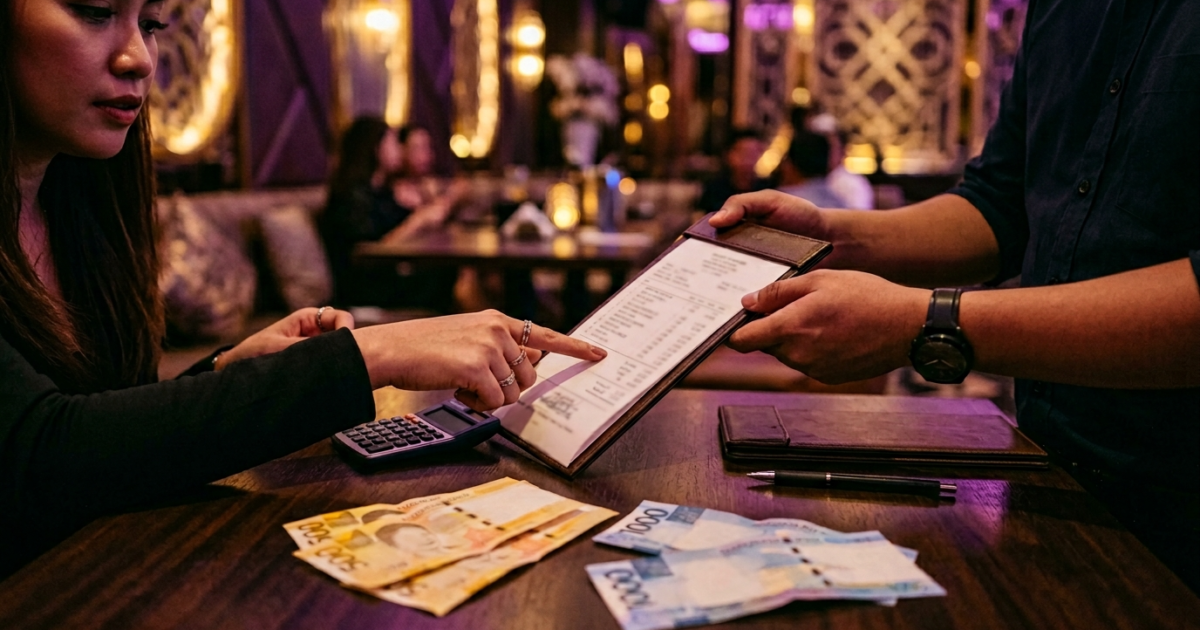
At Manila KTVs, the fees or set prices written on the menu do not simply become the final payment amount. Generally, “TAX” and a “service charge” are added to that, resulting in a total markup of around 28 percent.
The Destructive Power of an Approx 28 Percent Markup
- 1,000 peso set fee becomes approx 1,280 pesos in reality
- 10,000 peso bottle becomes approx 12,800 pesos in reality
Many a little makes a mickle. When the total amount grows large by buying drinks for the girls or opening bottles, a discrepancy of several thousand pesos arises just from this “28 percent” charge. This is the biggest reason why people get the illusion that they were “scammed!”.
They Usually Tell You About Extensions (The Pitfall of Large Groups)
There are experiences of “being charged a lot due to unauthorized extensions,” but actually, at excellent stores in Malate, staff or mamas will basically tell you, “It’s time, would you like to extend?” when the time comes.
Then why does “I didn’t hear that” happen? It is mainly a lack of communication when drinking in a large group.
It is very common for one person in the group to be asked about an extension by the staff, and they say “OK, let’s extend!” in the heat of the moment, resulting in other members not knowing and misunderstanding that it was “extended without permission.”
Not Just Inside the Store! Beware of Manila’s Unique “Outside Trouble”
We have explained billing troubles inside KTVs, but in Manila, you also need to be careful of troubles “outside the store.” This has nothing to do with store billing (scams), but the following three are typical cases that Japanese people easily get caught up in.
Examples of Common Outside Troubles
- Theft – Having cash stolen from your wallet while showering after bringing someone back to your hotel.
- Sob Stories – Being asked for remittances or money by appealing to emotions, citing reasons like family illness.
- Badger Game (Setup) – Going to a hotel with a woman of unknown background, only to be threatened by associates demanding settlement money.
Inside a KTV, there is a store manager or mama, but actions outside the store are entirely your own responsibility. Keep in the back of your mind that such risks lurk, and try to act cautiously.
Concrete Defense Strategies to Prevent Malicious Stores and Trouble
We have conveyed the raw reality of Manila’s unique “traps” and “troubles” so far, but there is no need to be excessively frightened.
If you choose an excellent store, correctly understand the local system, and take countermeasures in advance, Manila’s KTVs become the ultimate adult playground. Here, we will explain practical defense strategies to completely prevent unnecessary expenses and troubles.
Rely on the Internet and SNS Instead of Guides
The first step to preventing unnecessary trouble and unclear accounting is not to involve touts or guides.
If you find a KTV you are interested in, make it a habit to check the store’s official information yourself on the internet or SNS instead of following street touts.
Many excellent stores publish the latest information on websites and the like. To play safely and at a fair price, it is important not to swallow the words of a guide but to go get primary information with your own smartphone.
Do Not Let Them Drink Endlessly! Smart Way to Drink by Setting a Budget and Ordering a Bottle
To prevent the bill from skyrocketing inside a KTV, you need to devise how you order alcohol.
If you let Filipina casts drink 900-peso beers endlessly, you will go bankrupt in no time. Therefore, a play style often used by veterans accustomed to Manila is “order a bottle of tequila or similar from the start and don’t let them drink anything else.”
For example, a group of three goes to play and orders one bottle of tequila (approx 10,000 pesos and up). By strictly making the casts drink from that bottle, you can prevent the budget from hitting the ceiling due to per-glass additions.
What to Do If You Get Caught in High Billing or Trouble at a Malicious Store
No matter how much you keep prior countermeasures in mind, it can happen to anyone to inadvertently follow a tout out of a sense of travel liberation or get swept up in the atmosphere.
If you unfortunately step into a malicious store and fall into a pinch where you are “charged an exorbitant amount,” how should you handle it?
“Running Away” is Absolutely NG! Negotiate Calmly and Find a Landing Point
Attempting to force your way through, such as trying to escape from the store when they look away, is absolutely NG (suicidal behavior).
There is no guarantee you can escape in an unfamiliar land, and there is a risk of it escalating into violence if caught. Furthermore, if the police are called for dining and dashing, you will be cornered into a completely disadvantageous position.
Instead of running away, brace yourself and focus on finding a landing point to negotiate calmly and return safely.
Absolute Rules During Negotiation
- Do not shout loudly or hit the table (do not make them lose face).
- Absolutely do not take out your credit card (due to the danger of it being maxed out).
- Hide large bills in the back of your wallet beforehand and only show “cash on hand”.
- You do not need to pay the full amount, but have the mindset of “buying your safety”.
There are many cases where the other party also does not expect to “have this unreasonable billed amount paid beautifully in full.”
Show the contents of your wallet (a small amount) saying, “I cannot pay the full amount because I didn’t hear about the system. But this is all the cash I have on hand,” and negotiate with a resolute attitude.
Conclusion | Nightlife in Manila is All About Prior Knowledge and System Understanding
We have explained the realistic scam situation at Manila KTVs and defense strategies to protect yourself.
Seeing extreme experience stories on the internet or tales of being “charged exorbitant amounts,” you might feel excessive fear towards nightlife in Manila. However, as conveyed in the article, current Manila (especially Japanese KTV areas like Malate and Makati) is an attractive city that can be enjoyed safely as long as you have the correct knowledge.
Most scam damages and high billing stem from a lack of prior research and understanding of the fee system.
As long as you follow these basic rules, the probability of getting caught in unnecessary trouble will drop dramatically. The most important thing in Manila’s nightlife is to win the information war of “knowing or not knowing.”